

AI chatbots are everywhere.
From WhatsApp and Instagram to websites and customer portals, businesses are rushing to “add a chatbot”, hoping it will magically reduce workload, increase sales, and improve customer satisfaction.
But here’s the uncomfortable truth:
Most businesses don’t fail with AI chatbots because the technology doesn’t work.
They fail because they misunderstand what AI chatbots are actually meant to do.
Instead of improving customer experience, poorly implemented chatbots often:
-
Frustrate customers
-
Create more support tickets
-
Damage trust
-
Push buyers to competitors
This article breaks down what businesses commonly get wrong about AI chatbots, why those mistakes happen, and how to approach chatbot automation the right way, especially for customer-facing channels like WhatsApp.
Mistake #1 – Thinking AI Chatbots Are a Replacement for Humans
One of the biggest misconceptions is that AI chatbots exist to replace customer support teams.
They don’t.
AI chatbots are designed to support humans, not eliminate them.
What businesses expect:
-
Zero human involvement
-
Fully automated conversations
-
No need for agents anymore
What actually works:
-
Chatbots handle repetitive and predictable requests
-
Humans handle complex, emotional, or high-value conversations
Examples of tasks AI chatbots handle best:
-
FAQs (pricing, opening hours, delivery info)
-
Order status updates
-
Appointment booking
-
Lead qualification
-
Basic troubleshooting
According to Salesforce, customers still expect human assistance for complex issues, even in automated environments (Salesforce State of Service, 2024).
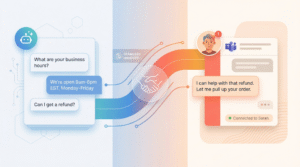
The winning model is hybrid support – AI + human agents working together.
Mistake #2 – Believing More Automation Automatically Means Better Customer Experience
Automation without strategy is dangerous.
Many businesses automate everything simply because they can — not because they should.
Common automation mistakes include:
-
Forcing customers through endless menus
-
Blocking access to human support
-
Overusing “Choose 1–5” reply flows
-
Sending irrelevant automated responses
Instead of helping, this creates customer friction.
According to HubSpot research, 90% of customers rate “immediate response” as important, but not at the cost of being understood (HubSpot Customer Experience Report, 2024).
The goal of automation should be:
-
Faster resolution
-
Clear guidance
-
Easy escalation to humans
Not confusion.
Mistake #3 – Treating AI Chatbots Like a One-Time Setup
Another major misconception is thinking:
“Once we install a chatbot, the work is done.”
In reality, AI chatbots require continuous improvement.
Why?
-
Customer questions evolve
-
Products change
-
Business processes improve
-
Customer language shifts
A chatbot trained once and ignored becomes outdated quickly.
Smart businesses:
-
Review chatbot conversations regularly
-
Identify unanswered questions
-
Improve response accuracy
-
Update flows based on real data
This is where platforms like Lulichat help businesses continuously optimize chatbot performance using real customer conversations, not assumptions.
Mistake #4 – Assuming AI Chatbots Understand Customers Automatically
AI is powerful, but it’s not magic.
Many businesses assume chatbots will instantly:
-
Understand slang
-
Interpret emotions
-
Handle vague messages
-
Know business context
Without proper training and conversation design, chatbots can misinterpret users, especially in regions like Nigeria where customers mix:
-
English
-
Pidgin
-
Abbreviations
-
Emojis
-
Voice notes (on WhatsApp)
The result?
-
Wrong responses
-
Repetitive replies
-
Frustrated customers
Effective chatbot deployment requires:
-
Context-aware training
-
Local language considerations
-
Clear fallback options
-
Easy transfer to agents
AI should assist understanding, not guess blindly.
Mistake #5 – Ignoring WhatsApp as a Core Support Channel
Many businesses still treat WhatsApp as:
-
An informal channel
-
A side inbox
-
A personal phone tool
But for customers especially in Africa WhatsApp is customer support.
According to Meta, over 175 million people message businesses daily on WhatsApp (Meta Business Data, 2024).
When businesses fail to:
-
Organize WhatsApp conversations
-
Automate basic replies
-
Assign chats to teams
-
Track response time
They lose customers without even realizing it.
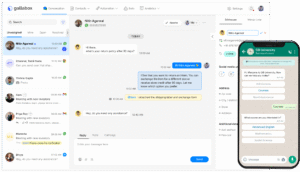
This is exactly why Lulichat focuses heavily on WhatsApp automation done properly, blending AI chatbots, team inboxes, and human escalation into one system.
You can also read “How to Optimize Customer Support with WhatsApp Automation”
Mistake #6 – Expecting AI Chatbots to Close Sales on Their Own
AI chatbots are great at:
-
Capturing leads
-
Qualifying prospects
-
Answering product questions
-
Booking demos or calls
But expecting them to fully replace human sales conversations is unrealistic — especially for high-consideration products or services.
Customers still want:
-
Reassurance
-
Clarification
-
Trust-building
-
Negotiation
Smart businesses use AI chatbots to:
-
Engage visitors instantly
-
Collect key information
-
Route hot leads to sales teams
This shortens the sales cycle instead of breaking it.
Mistake #7 – Choosing Chatbots Based on Hype, Not Business Needs
Many chatbot decisions are made based on:
-
Buzzwords
-
“AI-powered” labels
-
Trend pressure
-
Cheap pricing
Not on actual business requirements.
Before choosing a chatbot solution, businesses should ask:
-
Does it support WhatsApp properly?
-
Can humans take over conversations easily?
-
Does it scale with my team?
-
Can I track performance?
-
Is it built for my market?
Tools like Lulichat are designed specifically for SMEs and growing businesses, not just enterprise demos or generic global use cases.
Lastly, AI chatbots are not shortcuts to success.
They don’t fix broken processes.
They don’t replace human empathy.
They don’t work without strategy.
But when implemented correctly, they:
-
Improve response speed
-
Reduce workload
-
Increase customer satisfaction
-
Help teams focus on meaningful work
The difference between failure and success isn’t the chatbot itself —
It’s how businesses understand and use it.
If you’re considering AI chatbots or already using one, now is the time to ask:
Is it actually helping my customers, or just automating noise?
Explore how Lulichat helps businesses combine AI chatbots, WhatsApp automation, and human support, without losing the personal touch customers expect.